To talk through a problem: say it out loud. Verbalizing is one of the fastest ways to untangle a problem — the rubber-duck effect — because speech forces vague worry into concrete words. Jot AI records the ramble and structures it into a decision doc: the problem, your options, an approach, and next steps.
Why talking beats staring at a blank doc
A problem in your head is a cloud — every concern present at once, nothing in order, no beginning. A blank document doesn't fix that; it just adds the pressure of writing well to the pressure of deciding.
Speech is different, because speech is linear. You physically cannot say everything at once. The moment you start talking, you're forced to pick a first sentence, then a second, and suddenly the cloud has a sequence: here's what's stuck, here's why, here's what I could do about it.
Programmers have known this for decades as rubber-duck debugging: explain the problem out loud — even to a rubber duck — and the answer often surfaces mid-sentence. The duck contributes nothing. The explaining does everything.
The problem with thinking out loud alone
The catch: rubber ducks don't take notes. You talk through the trade-off on a walk, reach real clarity around minute four — and by the time you're back at a keyboard, the insight has evaporated. You remember deciding, but not the reasoning, not the option you ruled out, not the caveat that made you hesitate. So next week you re-litigate the whole thing from zero.
Thinking out loud produces your best raw thinking and then throws it away. What's been missing is the thing that catches it.
The Jot workflow: ramble in, decision doc out
- Tap the Problem shortcut. It sits right on Jot's home screen, next to Idea and Voice. One tap and you're recording, live waveform running.
- Ramble through what's stuck. Don't organize your thoughts first — that's the AI's job. Circle back, contradict yourself, say "actually, wait." Messy is the expected input.
- Stop, and let it structure. Jot transcribes the audio, then builds a Problem doc: a clear title, a STATUS line, your OPTIONS laid out, an APPROACH, and NEXT STEPS — stamped "Structured by AI from your voice note."
You spoke a tangle. You got back the document you would have written after an hour of deliberate work — except it took three minutes and happened while you were walking.
A worked example
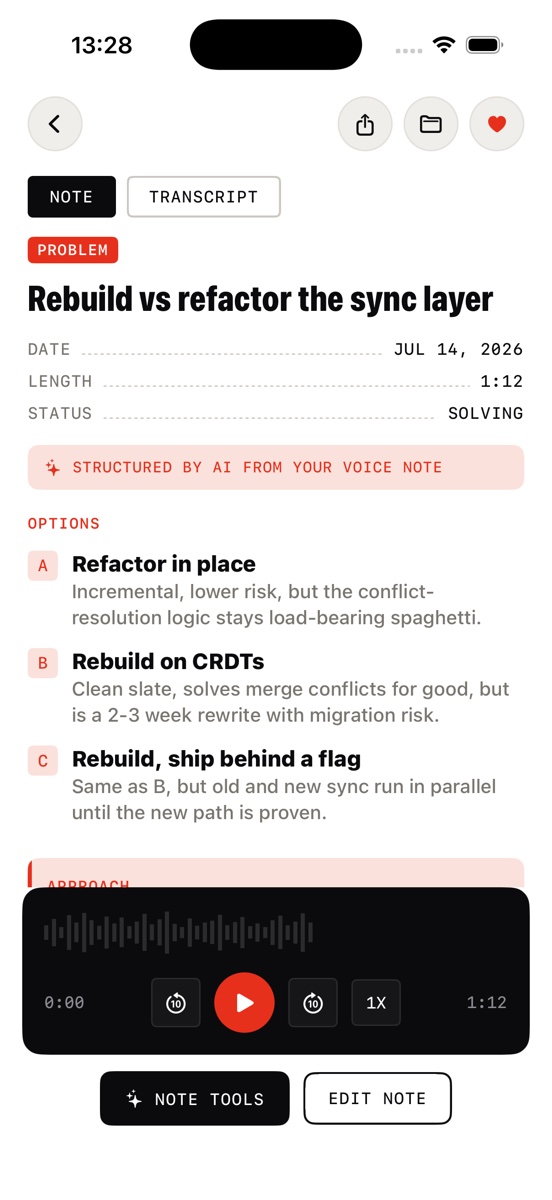
Say you're wrestling with a classic engineering dilemma: rebuild or refactor the sync layer? You hit Problem and talk: the sync code is brittle, a rewrite is cleaner but risky, refactoring is safer but slower, there's a deadline breathing down your neck, and honestly you're not sure the team can absorb a rewrite right now.
Jot hands back a doc titled "Rebuild vs refactor the sync layer", tagged PROBLEM, with the date, recording length, and status in crisp ledger rows. Below that: your OPTIONS (rebuild clean vs refactor incrementally) as you actually described them, an APPROACH distilled from where your reasoning was leaning, and NEXT STEPS pulled from every "I should probably…" you muttered along the way. Nothing invented — it's your thinking, finally in a shape you can act on.
Problems stay open until you close them
Real problems don't resolve in one recording, and Jot treats them that way. Each Problem doc carries a status — SOLVING, for one — so your open decisions are visible instead of buried in a notes pile. When you come back to it, everything is still there: replay the original audio with the built-in player, or flip the NOTE ↔ TRANSCRIPT toggle to reread your exact words when you need to check what you actually said versus what you remember saying.
When to talk it through
- Decisions — two viable paths and no obvious winner. Talking exposes which one you're already leaning toward, and why.
- Blockers — you're stuck and can't name why. Explaining the stuckness out loud is usually how you find the knot.
- Trade-offs — speed vs quality, cost vs scope. Saying the costs out loud makes them concrete enough to compare.
- Founder dilemmas — pricing, hiring, what to kill. The decisions with no one to delegate to are exactly the ones worth a Problem doc you can revisit.
The pattern is the same every time: if you've read the same paragraph three times or rewritten the same Slack message twice, stop typing and start talking.
Stuck on something right now?
Download Jot AI free, tap Problem, and talk through it for three minutes. See what comes back.
Download on the App Store