Voice journaling is keeping a daily journal by speaking instead of writing. You talk through your day — what happened, how it felt — and an app like Jot AI turns it into dated, mood-tagged entries you can browse on a calendar, with weekly mood trends and a streak to keep the habit alive.
Why journaling habits die
Almost nobody quits journaling because they stopped having thoughts. They quit because of the mechanics:
- The blank page. "Write about your day" is a surprisingly hard prompt when the cursor is blinking and nothing feels worth starting with.
- Typing at night. The natural journaling hour is the tired hour. After a full day, composing paragraphs on a phone keyboard feels like homework — so the entry becomes "tomorrow."
- Perfectionism. Once it's written down, it reads like it should be good. You reword, you trim, you judge — and the habit quietly turns into a chore you avoid.
Notice that all three are writing problems, not reflection problems. Remove the writing, and the habit gets dramatically easier to keep.
Talking beats writing for reflection
Speaking is how most of us actually process a day. You already do it — to a friend, a partner, the windshield on the drive home. Saying things out loud forces you to finish thoughts you'd otherwise loop on, and hearing yourself say "honestly, the meeting wasn't the problem" is often the moment you understand your own day.
It's also simply more material for less effort: about three minutes of relaxed talking comes out to roughly a full typed page. No sentence-crafting, no backspacing, no staring. You lie in bed, you talk, you're done — and you still get a written entry out of it, because the transcription and cleanup aren't your job anymore.
How voice journaling works in Jot
- Speak the entry — or write it. Tap record and talk through your day. On days you'd rather type a few lines, you can write the entry instead; the journal takes both.
- Tag the mood. A quick mood picker attaches how the day felt to what the day was — one tap, no scale-of-one-to-ten interrogation.
- It lands on the calendar. Every entry is dated and filed automatically, browsable as a calendar or a list. No folders to maintain, and it's all searchable later, right alongside your notes.
The feedback loop that keeps you going
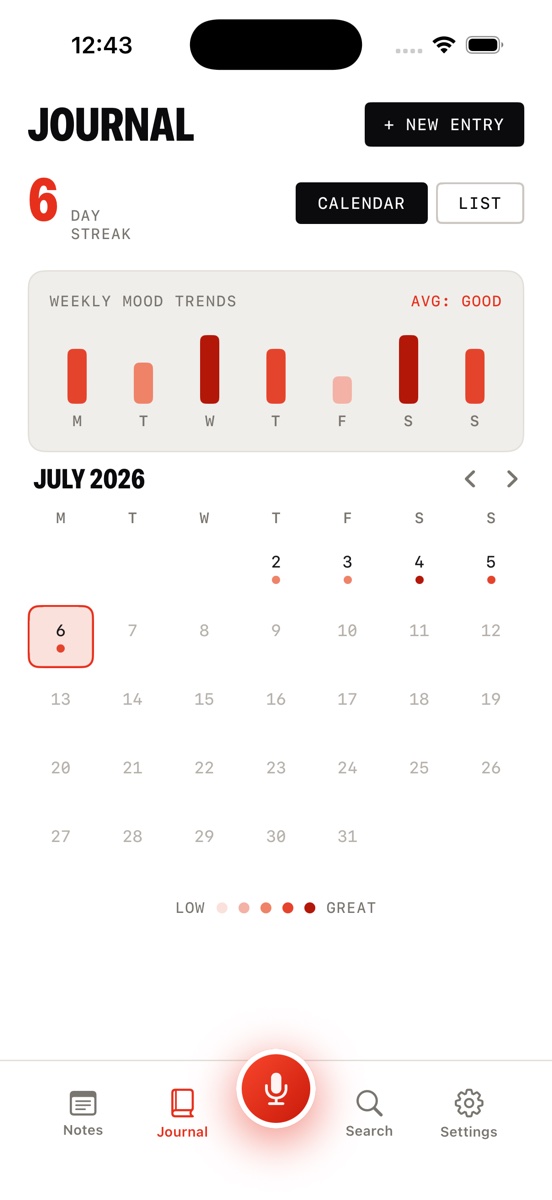
Habits survive on visible progress, and this is where a voice journal app earns its keep. In Jot, every mood you tag becomes a colored dot on the month's calendar — a glanceable picture of how the weeks actually went, not how you remember them going. A weekly mood trends chart turns those dots into a line you can read: the rough patch was real, and so was the recovery.
Then there's the day streak. Six days in a row is a small, stupidly effective reason to record a seventh. Together — dots, trend, streak — the journal stops being an obligation and starts being a scoreboard you want to keep filling in.
Three prompts to start tonight
If "talk about your day" feels too open, borrow one of these and just answer it out loud:
- "What actually happened today — and what did I expect to happen?" The gap between the two is usually the interesting part.
- "What's one moment I want to remember from today?" Small is fine. Small is usually better.
- "What am I still carrying into tomorrow?" Naming it out loud is half of putting it down.
A note on privacy
A journal only works if you're honest in it, and you're only honest when no one's watching. Your Jot journal isn't a feed and has no audience — no likes, no followers, nobody to perform for. Entries are yours to browse, search, and reread; your thoughts stay yours. Say the unflattering thing. That's the entry that will matter in six months.
Keep the journal you'll actually keep
Download Jot AI free, talk through tonight, tag the mood — and watch the calendar start to fill.
Download on the App Store